Saturday, 26 October 2013

Research question and answers I have constructed to help guide my writing process

Thanks to Simon Hopper, my dyslexia support tutor, I was able to construct a guide to writing my work before I had started. His #1 advice was to know what my point was, or what I wanted to say and why that mattered before any writing took place. To help myself to this I have written down my research question, answered it briefly and then composed a short explanation as to the importance of such research.

As it will not be included in the final dissertation I would like to record it here:

Q: how can artists and designers justify using the crowd to generate their work?

A: by releasing the results back into the crowd with emphasis on crediting the contributions to deal with issues surrounding authorship.
Doing so should let the crowd analyse the results and learn new things about its own capabilities.

Q: So what?

A: Today we are always part of the crowd, yet we do not fully understand what it is capable of. Therefore, anything we do that allows us to grow more aware as a crowd is beneficial and essential for us as individuals.

The index for my dissertation

I had a very positive tutorial where it was highlighted that I had to make some structural refinements to my work, but that it is otherwise engaging. I have therefore created an index for my near finished work:

I. Introduction
II. Why is it worth talking about the crowd?
III. Case Studies
A. Casey Pugh: Star Wars uncut
B. Daniel Eatock: Contributions
C. Yayoi Kusama's Obliteration Room
IV. Analysis
V. Conclusion

Friday, 18 October 2013

More on authorship

The OP to the crowd sourced work serves as the wrapping paper serves the sweet. You look for the containing frame to experience the content and once you consume it you are left with the wrapping as the reference to the experience. if you want to experience a similar sensation again (flavour/content) you look for the artist or the purple Cadbury wrap.

Thursday, 17 October 2013

New Questions to lead my case study research

I will show how using the product of the crowd's work is justified by its eventual reinterpretation and rerelease into the crowd:
How is content commissioned?:
general requirement
specific limitation
How is it presented in the interim stage?
How is the final outcome presented?

I will discuss if giving credit to the different contributors help resolve the question of authorship that may rise in some of these works:
What possible authorship related arguments may arise?
is credit given?:
in what form?
Does it help to solve the issues? How?


(analysis) To conclude, I will try to determine if these work allow the crowd to become more aware of its own potential and make it wiser:
Are the results available to the crowd as a whole? By what means?
What kind of conclusions, which are relevant to the crowd, can these case studies lead to?
Is there evidence to show that the crowd, post study case is wiser?

On the question of authorship

It is important to credit contributions because we are, on the whole, prepared to suffer if it means no other person gets to take advantage of us (TWoC, HCE). This means that if we feel the process of a research is unfair, we may be reluctant to learn from its outcomes. Yayoi Kusama’s Obliteration Room highlights this by limiting how contributions may differ from each other. An individual's input is always unique, if you put two of them side by side you will see the difference. Yet when you clump hundreds together, who did what seems irrelevant. Look at your own input - it may have some sentimental significance, but you care just as much that the collaboration with others created something. If you don't - someone else will...

Tuesday, 15 October 2013

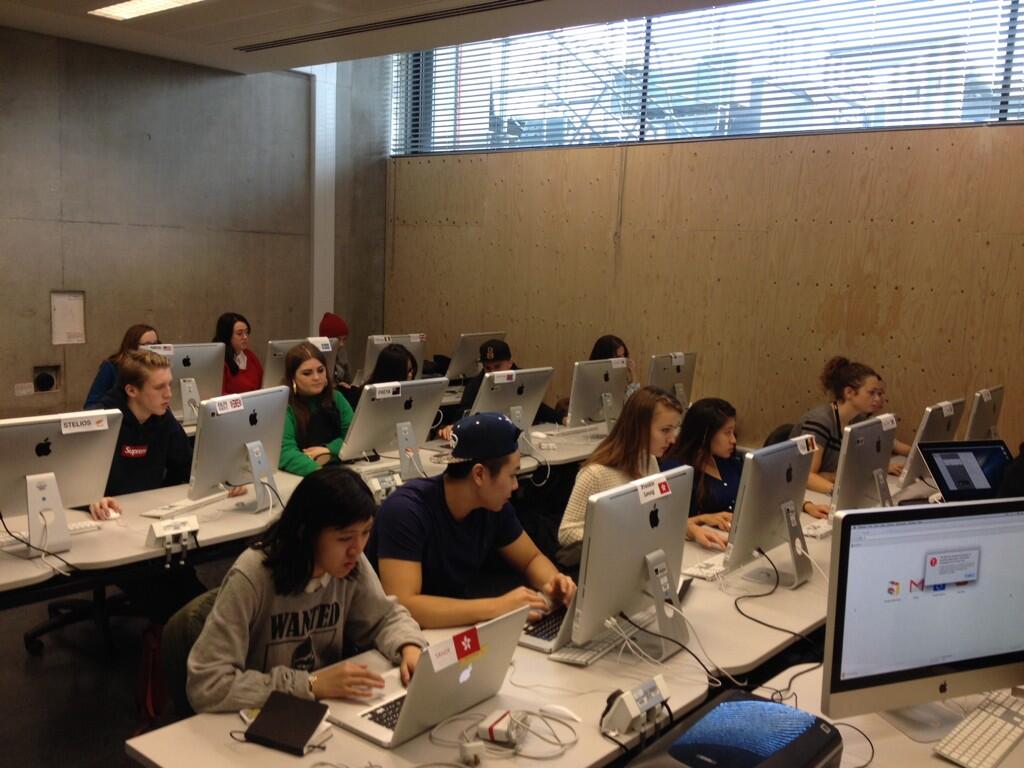
The first compilation of my dissertation as designed by the crowd is ready


After letting a group of first year Graphic Design BA temper with my work I have an initial compilation of the intro and research report.

It took about 1.5 hours - I was hoping for 20 mins max

I have a few issues to sort out such as making the participation less time consuming. Overall the process was fantastic!

Monday, 14 October 2013

crowddd

I created a website that would allow anyone to participate in the design of my dissertation.

At this stage I will not be posting this on Reddit etc. because it I am afraid it will look self serving and too complicated.

If I acquire the technical knowledge to make the entire participation in this project simple and browser native then I may act differently in the future.

Working on the template for my crowd generated dissertation design


Wednesday, 9 October 2013

Letter to Andrea

Hi Andrea,

Following our meeting on Friday I want to let you know of my thoughts regarding the presentation and content of my dissertation.

As I mentioned on Friday, I wish to form my thesis presentation out of the work of other people. I will give contributors portions of the text along with some instructions (page format, colour pallet, what they must include in the design etc.). Once their work is completed I will collate the results, edit them in some way and produce the integrated piece of design U9 requires.

You pointed out that if I do that then the content of the dissertation must reflect this process. Therefore my case studies should be examples of art and design works where other people's contribution is integral and reflected in the work itself.
How are these?
Pugh - Starwarsuncut.com
Daniel Eatock's - participation projects www.eatock.com
Kusama - obliteration room http://interactive.qag.qld.gov.au/looknowseeforever/works/obliteration_room/

This feels different from what I had in mind and as much as I find it an interesting subject, at the moment I don't feel as though I have a point worth making about this phenomenon.

I need help to determine what my conclusion can be. 
So far I have the following structure for the 'new' dissertation
Title: Designers that use other people to produce their work
What part of the work are they responsible for? > who should get the credit? > authorship?
What do the other participants get in return for their contribution?
What are the implication of this for design in the future?

The last question concerns me the most, i feel that if I have a good take on that it can form my conclusion and I will need only to flesh out the rest of the work.

I really appreciate your advice and look forward to hearing from you.

Regards,

Gilad

Tuesday, 8 October 2013

After the dissertation structure workshop yesterday

Not sure exactly how these will help me - but they show relationships between key elements in my work.
Below the images a breakdown of the structure can be found (automatically generated so not easy to follow)


Internet
I.      information is easy to find
A.   Authorship is easy to determine
All data regarding the creation of content online (i.e. when it was made and by whom) is logged, recorded and is becoming easier to navigate through (and easier to understand). Therefore, we can assume that our contributions will have our signature for good or bad.
pattern
1.   power law distribution
Social Tools
driven by
I.      Genuine/Self interested motives
A.   Authorship
B.   Actions
1.   retweets
a.   qouting
2.   reposts (reddit)
3.   upvotes/downvotes (reddit)
a.   voting systems
4.   facebook likes
5.   report to admins
main drive
C.   Financial motivation
D.   How should the individual engage with the crowd?
It is impotant to be genuine!
Whatever results croudsourcing gives us represent reality. The most meaningful representation of outcomes will be those true to the content generated by the crowd, as it exposes a part of it's true nature.
Purpose driven application
II.     Crowd Sourcing
always feature
III.    rules / guidelines
consequential
IV.    Content generation
A.   Competition
implies
1.   single winning outcome
collective piece is not the purpose
a.   Why I decided not to focus on this
B.   Crowd Sourced content
mutual contribution
1.   The individual
Moderation
Who will determine the results of our work?
I.      If we want to generate design by engaging with crowdsourcing than the result of our work will be determined crowd.
A.   The role of the designer is to initiate but not to control the ultimate consequences of the design
1.   What can designers do?
a.   test the system ourselves
b.   Designing the framework \ platform for all the subsequent work
c.    coming up with rules/guidlines based on ongoing experience or other limitation
d.   accept input from other users
What role can we play in the creative process?
if we initiated the work
I.      The pattern of social and collective effort is a power law. So as designers we start by being the party which contributes the most (nearest the y axis)
when we join an existing work
II.     our own genuine/self interested motives will determine our place among the contributors

Sunday, 22 September 2013

Revising the point I want to make

Almost everything we do nowadays generates content, which is recorded and is increasingly available to everyone else.
Increased use of social tools is exposing the true differences and similarities between us. This is creating wide consensus is making us more tolerant to certain things and adverse to others. Large groups (which I am to prove are equipped with 'bullshit-metres') can be formidable when an individual is facing them. In order to find acceptance within such a group, one is best course of action is to be genuine. This is true even before the wish to belong to said group has arisen, when there was no apparent need to be sincere, because our recorded generated content and past interactions serve as our reputation.

Revised Research Question

New social tools are rapidly changing the way groups communicate, plan and execute actions. We are almost constantly connected to everyone we know and have the potential of connecting with countless others. In other words we are constantly a part of the crowd.
How should we as individuals behave when we engage with it?

Friday, 20 September 2013

How to interrogate Case Studies

Here are the research questions I will ask about all case studies:
1) what is the case study, who made it, when?
2) how is content generated (the system)?
3) how freely available is the content (based on what level of access I have to it)?
4) how does it reflect on the differences and similarities between contributors?
5) what power does the crowd have to moderate content?
6)are there rules all participants must adhere to?
7) what tracks to participants leave?

Wednesday, 7 August 2013

Reading The Crowd: A Study of the Popular Mind by Gustave Le Bon


A crowd is like a giant, if its brain cells are well connected, then he is not only bigger and stronger than the smaller man, he is also wiser.
If the giant is motivated by instinct then the most it can do when he has an itchy forearm is to scratch. But a well-connected, self aware and remembering giant may come to realise that his body reacts adversely to certain irritations, find out what caused the rash and avoid it. In a similar way the well-connected group can realise and indorse codes of conduct which define what is desirable and what is unwelcomed so that individuals within the crowd regulate themselves.

That is something I think Le Bon could not have realised because the means to stay connected within a crowd (such as mobile technology) did not exist in 1896. His entire book is available online for free.


"... [a crowd's lasting belief] is usually only to be changed at the cost of violent revolutions. Even revolutions can only avail when the belief has almost entirely lost its sway over men's minds. In that case revolutions serve to finally sweep away what had already been almost cast aside, though the force of habit prevented its complete abandonment. The beginning of a revolution is in reality the end of a belief." (p.150)1


His note that 'force of habit' is a factor in tying groups together, suggests that it alone is not a good enough reason for a group to remain in existence. This highlights the fact that groups inspect their internal workings and ‘self worth’. It also alludes to the fact that a crowds’ bias to survive leads it to search for new justifications for its continuation. Crowds do not want to die and they will fight to survive.

1 Crowd : a study of the popular mind / Gustave Le Bon. / Le Bon, Gustave, 1841-1931. / Electronic Text Center, University of Virginia Library


Friday, 2 August 2013

My conclusion - the point I want to make


Almost everything we do nowadays generates content, which is recorded and is increasingly available to everyone else.
The increased use of social tools is exposing the true differences and similarities between us. This is creating wide consensuses making us more tolerant to certain things and adverse to others.
Large groups, which I am to prove are equipped with bullshit-meter, can be formidable when an individual is facing them. In order to find acceptance within such a group, one’s best course of action is to be genuine. This is true even before the wish to belong to said group had arisen, when there was no apparent need to be sincere. Our recorded generated content and past interactions serve as our reputation.